Class WorldAfterEvents
Index
Constructors
Properties
Constructors
Privateconstructor
-
Returns WorldAfterEvents
Properties
Readonlyblock
Privilege
early-execution-readable - This property can be read in early-execution mode.
Readonlyblock
Privilege
early-execution-readable - This property can be read in early-execution mode.
Readonlyblock
Remarks
This event fires for each BlockLocation destroyed by an explosion. It is fired after the blocks have already been destroyed.
Privilege
early-execution-readable - This property can be read in early-execution mode.
Example: setBlockBack.ts
import { world, BlockExplodeAfterEvent } from "@minecraft/server";
world.afterEvents.blockExplode.subscribe((event: BlockExplodeAfterEvent) => {
console.log("Block:", event.block);
console.log("Dimension:", event.dimension);
console.log("Exploded Block Permutation:", event.explodedBlockPermutation);
console.log("Source:", event.source);
// set block back
event.block.setPermutation(event.explodedBlockPermutation);
});
Readonlybutton
Privilege
early-execution-readable - This property can be read in early-execution mode.
Readonlydata
Remarks
This event is fired when an entity event has been triggered that will update the component definition state of an entity.
Privilege
early-execution-readable - This property can be read in early-execution mode.
Example: sheepEventListener.ts
import { world, system, Entity } from "@minecraft/server";
// Event id to trigger to sheeps
const eventId = "minecraft:entity_spawned";
system.runInterval(() => {
for (let player of world.getAllPlayers()) {
let [entityRaycaseHit] = player.getEntitiesFromViewDirection({ maxDistance: 150 });
if (!entityRaycaseHit) continue;
let entity = entityRaycaseHit.entity;
if (entity?.typeId === "minecraft:sheep") {
listenTo(entity);
entity.triggerEvent(eventId);
}
}
});
// Detect component groups that are added and removed, and other
// entity definition events fired when this event fires.
function listenTo(entity: Entity) {
const callback = world.afterEvents.dataDrivenEntityTrigger.subscribe(
(data) => {
world.afterEvents.dataDrivenEntityTrigger.unsubscribe(callback);
data.getModifiers().forEach((modifier) => {
console.log("ComponentGroupsToAdd:", modifier.addedComponentGroups);
console.log("ComponentGroupsToRemove:", modifier.removedComponentGroups);
console.log("Triggers:", modifier.triggers);
});
},
{ entities: [entity], eventTypes: [eventId] },
);
}
Readonlyeffect
Privilege
early-execution-readable - This property can be read in early-execution mode.
Example: effectAdd.js
import { world } from "@minecraft/server";
world.afterEvents.effectAdd.subscribe(
(event) => {
const { effect, entity } = event;
// Send a message about the effect being added
world.sendMessage(`Effect ${effect.typeId} was added to ${entity.typeId}`);
},
{
entityTypes: ["minecraft:player"], // Only track effects on players
},
);
Readonlyentity
Privilege
early-execution-readable - This property can be read in early-execution mode.
Readonlyentity
Privilege
early-execution-readable - This property can be read in early-execution mode.
Readonlyentity
Privilege
early-execution-readable - This property can be read in early-execution mode.
Readonlyentity
Privilege
early-execution-readable - This property can be read in early-execution mode.
Readonlyentity
Privilege
early-execution-readable - This property can be read in early-execution mode.
Example: logger.js
import { world } from "@minecraft/server";
world.afterEvents.entityHealthChanged.subscribe(
(event) => {
const { entity, oldValue, newValue } = event;
// Only show health changes for players
if (entity.typeId === "minecraft:player") {
world.sendMessage(`${entity.nameTag} health changed from ${oldValue} to ${newValue}`);
}
},
{
entityTypes: ["minecraft:player"],
},
);
Readonlyentity
Privilege
early-execution-readable - This property can be read in early-execution mode.
Example: hitBlock.js
import { world } from "@minecraft/server";
// Subscribes to the entityHitBlock event, triggering when an entity collides with a block.
world.afterEvents.entityHitBlock.subscribe((event) => {
const {
damagingEntity, // The entity that hit the block.
hitBlock, // The block that was hit.
hitBlockPermutation,
} = event;
world.sendMessage(
`${damagingEntity.typeId} hit a ${hitBlockPermutation.type.id} at ${hitBlock.location.x}, ${hitBlock.location.y}, ${hitBlock.location.z}`,
);
});
Readonlyentity
Privilege
early-execution-readable - This property can be read in early-execution mode.
Example: getDistance.js
import { world } from "@minecraft/server";
world.afterEvents.entityHitBlock.subscribe((event) => {
const location1 = event.damagingEntity.location;
const location2 = event.hitBlock.location;
const distance = Math.pow(
Math.pow(location2.x - location1.x, 2) +
Math.pow(location2.y - location1.y, 2) +
Math.pow(location2.z - location1.z, 2),
0.5,
);
console.log("Distance: " + distance + " blocks");
});
Readonlyentity
Privilege
early-execution-readable - This property can be read in early-execution mode.
Readonlyentity
Privilege
early-execution-readable - This property can be read in early-execution mode.
Readonlyentity
Privilege
early-execution-readable - This property can be read in early-execution mode.
Readonlyentity
Privilege
early-execution-readable - This property can be read in early-execution mode.
Example: inform.ts
import { world } from "@minecraft/server";
// Subscribe to the EntityLoadAfterEvent
const entityLoadSubscription = world.afterEvents.entityLoad.subscribe((event) => {
// Handle the entity load event
world.sendMessage(`Entity loaded: ${event.entity.typeId}`);
// Unsubscribe so the message doesn't appear after fired
world.afterEvents.entityLoad.unsubscribe(entityLoadSubscription);
});
Readonlyentity
Remarks
Fires when an entity is removed (for example, potentially unloaded, or removed after being killed).
Privilege
early-execution-readable - This property can be read in early-execution mode.
Example: subscribe.js
import { system, world } from "@minecraft/server";
// Subscribe to the entityRemove event, which is triggered when an entity is removed from the world
world.afterEvents.entityRemove.subscribe((eventData) => {
// Extract the type ID of the removed entity from the event data
const { typeId } = eventData;
// Send a message to all players in the world indicating that an entity of the given type has been removed
world.sendMessage(`Entity ${typeId} got removed`);
});
/*
Explanation:
This script listens for the `entityRemove` event, which occurs when an entity is removed from the Minecraft world.
- **Event Subscription**:
The `world.afterEvents.entityRemove.subscribe` method registers a callback function to handle the event whenever an entity is removed.
- **Extracting Entity Type**:
The `typeId` property from the `eventData` object contains the identifier of the removed entity's type.
- **Sending a Message**:
The script constructs a message indicating which type of entity was removed and sends this message to all players in the world using `world.sendMessage`.
Usage:
When an entity is removed (e.g., due to despawning, being killed, or otherwise removed), this script will automatically notify all players in the game with a message stating the type of the removed entity.
/
Readonlyentity
Privilege
early-execution-readable - This property can be read in early-execution mode.
Example: spawnMessage.js
import { world } from "@minecraft/server";
// Subscribe to entitySpawn event, so it sends a message when an entity is spawn into a world.
world.afterEvents.entitySpawn.subscribe((event) => {
const { entity } = event;
// Sends a message to world.
world.sendMessage(`${entity.typeId} is spawned`);
});
Readonlyentity
Privilege
early-execution-readable - This property can be read in early-execution mode.
Readonlyentity
Privilege
early-execution-readable - This property can be read in early-execution mode.
Readonlyentity
Privilege
early-execution-readable - This property can be read in early-execution mode.
Readonlyentity
Privilege
early-execution-readable - This property can be read in early-execution mode.
Readonlyexplosion
Privilege
early-execution-readable - This property can be read in early-execution mode.
Example: log.ts
import { world } from "@minecraft/server";
// Subscribe to the ExplosionAfterEvent
const explosionSubscription = world.afterEvents.explosion.subscribe((event) => {
console.log(`Explosion occurred in dimension ${event.dimension.id}`);
if (event.source) {
console.log(`Explosion source: ${event.source.typeId}`);
} else {
console.log(`Explosion source: None`);
}
const impactedBlocks = event.getImpactedBlocks();
console.log(`Impacted blocks: ${JSON.stringify(impactedBlocks)}`);
});
// ... Later in your code, when you want to unsubscribe
world.afterEvents.explosion.unsubscribe(explosionSubscription);
Readonlygame
Privilege
early-execution-readable - This property can be read in early-execution mode.
Example: subscribe.js
import { world } from "@minecraft/server";
// Subscribe to the gameRuleChange event, which is triggered when a game rule is updated
world.afterEvents.gameRuleChange.subscribe((eventData) => {
// Extract the game rule name and its new value from the event data
const { rule, value } = eventData;
// Send a message to all players in the world indicating that a game rule has been updated
world.sendMessage(`Gamerule ${rule} updated to ${value}`);
});
/*
Explanation:
This script listens for the `gameRuleChange` event, which occurs when a game rule is modified in Minecraft.
- **Event Subscription**:
The `world.afterEvents.gameRuleChange.subscribe` method registers a callback function to handle the event whenever a game rule changes.
- **Extracting Information**:
- `rule` provides the name of the game rule that was changed.
- `value` indicates the new value of the game rule.
- **Sending Notification**:
- The script constructs a message that includes the name of the updated game rule and its new value, then sends this message to all players in the world using `world.sendMessage`.
Usage:
When a game rule is changed, this script automatically notifies all players with a message that includes the name of the updated game rule and its new value. This is useful for tracking changes to game rules and keeping players informed about the current game settings.
/
Readonlyitem
Privilege
early-execution-readable - This property can be read in early-execution mode.
Example: subscribe.js
import { world } from "@minecraft/server";
// Subscribe to the itemCompleteUse event, which is triggered when a player completes using an item
world.afterEvents.itemCompleteUse.subscribe((eventData) => {
// Extract the player who used the item and the item stack from the event data
const { source, itemStack } = eventData;
// Construct a message indicating the player's name and the type of item they used
world.sendMessage(`Player ${source.nameTag} completed use of item (${itemStack.typeId})`);
});
/*
Explanation:
This script listens for the `itemCompleteUse` event, which occurs when a player finishes using an item in Minecraft.
- **Event Subscription**:
The `world.afterEvents.itemCompleteUse.subscribe` method registers a callback function to handle the event whenever an item use is completed.
- **Extracting Information**:
- `source` represents the player who used the item.
- `itemStack` provides details about the item stack, including its type ID.
- **Sending Notification**:
- The script constructs a message that includes the player's name and the type ID of the item they used. This message is then sent to all players in the world using `world.sendMessage`.
Usage:
When a player completes using an item (such as consuming a potion or using a tool), this script sends a notification to all players in the game, indicating which player used which item. This can be useful for tracking item usage or for general game management.
/
Readonlyitem
Privilege
early-execution-readable - This property can be read in early-execution mode.
Example: subscribe.js
import { world } from "@minecraft/server";
// Subscribe to the `itemReleaseUse` event, which is triggered when a player releases the use of an item
world.afterEvents.itemReleaseUse.subscribe((eventData) => {
const { source, itemStack } = eventData;
world.sendMessage(`${source.nameTag} released the use of item ${itemStack.typeId}`);
});
Readonlyitem
Privilege
early-execution-readable - This property can be read in early-execution mode.
Example: subscribe.js
import { world } from "@minecraft/server";
// Subscribe to the `itemStartUse` event, which is triggered when a player starts using an item
world.afterEvents.itemStartUse.subscribe((eventData) => {
const { source, itemStack } = eventData;
world.sendMessage(`${source.nameTag} started using item ${itemStack.typeId}`);
});
Readonlyitem
Remarks
This event fires when a player successfully uses an item or places a block by pressing the Use Item / Place Block button. If multiple blocks are placed, this event will only occur once at the beginning of the block placement. Note: This event cannot be used with Hoe or Axe items.
Privilege
early-execution-readable - This property can be read in early-execution mode.
Example: subscribe.js
import { world } from "@minecraft/server";
// Subscribe to the `itemStartUseOn` event, which is triggered when a player starts using an item on a block
world.afterEvents.itemStartUseOn.subscribe((eventData) => {
const { source, block, itemStack } = eventData;
const { x, y, z } = block.location;
world.sendMessage(`${source.nameTag} started using item ${itemStack.typeId} on block at ${x}, ${y}, ${z}`);
});
Readonlyitem
Privilege
early-execution-readable - This property can be read in early-execution mode.
Example: subscribe.js
import { world } from "@minecraft/server";
// Subscribe to the `itemStopUse` event, which is triggered when a player stops using an item
world.afterEvents.itemStopUse.subscribe((eventData) => {
const { source, itemStack } = eventData;
world.sendMessage(`${source.nameTag} stopped using item ${itemStack.typeId}`);
});
Readonlyitem
Remarks
This event fires when a player releases the Use Item / Place Block button after successfully using an item. Note: This event cannot be used with Hoe or Axe items.
Privilege
early-execution-readable - This property can be read in early-execution mode.
Example: subscribe.js
import { world } from "@minecraft/server";
// Subscribe to the `itemStopUseOn` event, which is triggered when a player stops using an item on a block
world.afterEvents.itemStopUseOn.subscribe((eventData) => {
const { source, block, itemStack } = eventData;
const { x, y, z } = block.location;
world.sendMessage(`${source.nameTag} stopped using item ${itemStack.typeId} on block at ${x}, ${y}, ${z}`);
});
Readonlyitem
Privilege
early-execution-readable - This property can be read in early-execution mode.
Readonlylever
Privilege
early-execution-readable - This property can be read in early-execution mode.
Example: subscribe.js
// Script by WavePlayz
import { world } from "@minecraft/server";
// Subscribe to the `leverAction` event, which is triggered when a player interacts with a lever
world.afterEvents.leverAction.subscribe((eventData) => {
const { player, block, isPowered } = eventData;
const { x, y, z } = block.location;
world.sendMessage(`${player.name} toggled a lever at ${x}, ${y}, ${z}. Lever is now ${isPowered ? "ON" : "OFF"}`);
});
Example: Subscribe to the leverAction event, which is triggered when a player interacts with a lever.
// Script by WavePlayz
import { world } from "@minecraft/server";
world.afterEvents.leverAction.subscribe(eventData => {
const { source, block, powered } = eventData;
const { x, y, z } = block.location;
world.sendMessage(`${source.name} toggled a lever at ${x}, ${y}, ${z}. Lever is now ${powered ? "ON" : "OFF"}`);
});
Readonlypiston
Privilege
early-execution-readable - This property can be read in early-execution mode.
Example: subscribe.js
import { world } from "@minecraft/server";
// Subscribe to the `pistonActivate` event, which is triggered when a piston extends or retracts
world.afterEvents.pistonActivate.subscribe((eventData) => {
const { block, isExpanding } = eventData;
const { x, y, z } = block.location;
world.sendMessage(`Piston at ${x}, ${y}, ${z} is ${isExpanding ? "extending" : "retracting"}`);
});
Readonlyplayer
Privilege
early-execution-readable - This property can be read in early-execution mode.
Example: subscribe.js
import { world } from "@minecraft/server";
world.afterEvents.playerBreakBlock.subscribe((event) => {
const { brokenBlockPermutation, player } = event;
if (brokenBlockPermutation.type.id === "minecraft:grass") {
player.sendMessage("You broke a grass block!");
}
if (brokenBlockPermutation.type.id === "minecraft:stone") {
player.sendMessage("You broke a stone block!");
}
});
Readonlyplayer
Remarks
This event fires when an InputButton state is changed.
Privilege
early-execution-readable - This property can be read in early-execution mode.
Readonlyplayer
Privilege
early-execution-readable - This property can be read in early-execution mode.
Readonlyplayer
Privilege
early-execution-readable - This property can be read in early-execution mode.
Example: subscribe.js
import { world } from "@minecraft/server";
// Subscribe to the `playerDimensionChange` event, which is triggered when a player changes dimensions
world.afterEvents.playerDimensionChange.subscribe((eventData) => {
const { player, fromDimension, toDimension } = eventData;
world.sendMessage(`${player.name} moved from ${fromDimension.id} to ${toDimension.id}`);
});
Readonlyplayer
Privilege
early-execution-readable - This property can be read in early-execution mode.
Example: subscribe.js
import { world } from "@minecraft/server";
// Subscribe to the `playerEmote` event, which is triggered when a player performs an emote
world.afterEvents.playerEmote.subscribe((eventData) => {
const { player, personaPieceId } = eventData;
world.sendMessage(`${player.name} performed emote ${personaPieceId}`);
});
Readonlyplayer
Privilege
early-execution-readable - This property can be read in early-execution mode.
Example: subscribe.js
import { world } from "@minecraft/server";
// Subscribe to the `playerGameModeChange` event, which is triggered when a player changes their game mode
world.afterEvents.playerGameModeChange.subscribe((eventData) => {
const { player, toGameMode } = eventData;
world.sendMessage(`${player.name} changed game mode to ${toGameMode}`);
});
Readonlyplayer
Privilege
early-execution-readable - This property can be read in early-execution mode.
Readonlyplayer
Remarks
This event fires when a player's InputMode changes.
Privilege
early-execution-readable - This property can be read in early-execution mode.
Readonlyplayer
Privilege
early-execution-readable - This property can be read in early-execution mode.
Example: subscribe.js
import { world } from "@minecraft/server";
// Subscribe to the `playerInputPermissionCategoryChange` event, which is triggered when a player's input permissions change
world.afterEvents.playerInputPermissionCategoryChange.subscribe((eventData) => {
const { player, category, enabled } = eventData;
world.sendMessage(`${player.name} ${enabled ? "enabled" : "disabled"} input permission category ${category}`);
});
Readonlyplayer
Privilege
early-execution-readable - This property can be read in early-execution mode.
Example: subscribe.js
import { world } from "@minecraft/server";
// Subscribe to the `playerInteractWithBlock` event, which is triggered when a player interacts with a block
world.afterEvents.playerInteractWithBlock.subscribe((eventData) => {
const { player, block } = eventData;
const { x, y, z } = block.location;
world.sendMessage(`${player.name} interacted with block at ${x}, ${y}, ${z}`);
});
Readonlyplayer
Privilege
early-execution-readable - This property can be read in early-execution mode.
Example: subscribe.js
import { world } from "@minecraft/server";
// Subscribe to the `playerInteractWithEntity` event, which is triggered when a player interacts with an entity
world.afterEvents.playerInteractWithEntity.subscribe((eventData) => {
const { player, target, beforeItemStack, itemStack } = eventData;
const { x, y, z } = target.location;
if (!itemStack && !beforeItemStack) {
world.sendMessage(`${player.name} interacted with entity at ${x}, ${y}, ${z}`);
} else {
world.sendMessage(
`${player.name} interacted with entity at ${x}, ${y}, ${z} with ${beforeItemStack.typeId} (now ${itemStack.typeId})`,
);
}
});
Readonlyplayer
Privilege
early-execution-readable - This property can be read in early-execution mode.
Readonlyplayer
Remarks
This event fires when a player joins a world. See also playerSpawn for another related event you can trap for when a player is spawned the first time within a world.
Privilege
early-execution-readable - This property can be read in early-execution mode.
Readonlyplayer
Privilege
early-execution-readable - This property can be read in early-execution mode.
Readonlyplayer
Privilege
early-execution-readable - This property can be read in early-execution mode.
Example: subscribe.js
import { world } from "@minecraft/server";
// Subscribe to the `playerPlaceBlock` event, which is triggered when a player places a block
world.afterEvents.playerPlaceBlock.subscribe((eventData) => {
// Destructure the eventData to get the player who placed the block and the block itself
const { player, block } = eventData;
// Extract the x, y, and z coordinates from the block's location
const { x, y, z } = block.location;
// Format the coordinates as a string
const coordinates = `${x}, ${y}, ${z}`;
// Construct a message indicating which player placed which block and where
const message = `${player.name} placed ${block.typeId} at location ${coordinates}`;
// Send the message to all players in the world
world.sendMessage(message);
});
Readonlyplayer
Remarks
This event fires when a player spawns or respawns. Note that an additional flag within this event will tell you whether the player is spawning right after join vs. a respawn.
Privilege
early-execution-readable - This property can be read in early-execution mode.
Readonlyplayer
Privilege
early-execution-readable - This property can be read in early-execution mode.
Readonlyplayer
Privilege
early-execution-readable - This property can be read in early-execution mode.
Readonlypressure
Privilege
early-execution-readable - This property can be read in early-execution mode.
Example: subscribe.js
import { world } from "@minecraft/server";
// Subscribe to the `pressurePlatePop` event, which is triggered when a player steps off a pressure plate
world.afterEvents.pressurePlatePop.subscribe((eventData) => {
// Extract the block (pressure plate) that was released
const { block } = eventData;
// Extract the x, y, and z coordinates from the block's location
const { x, y, z } = block.location;
// Format the coordinates as a string
const coordinates = `${x}, ${y}, ${z}`;
// Construct a message indicating that a pressure plate at a specific location was released
const message = `Pressure plate at location ${coordinates} was released`;
// Send the message to all players in the world
world.sendMessage(message);
});
Readonlypressure
Privilege
early-execution-readable - This property can be read in early-execution mode.
Example: subscribe.js
import { Player, world } from "@minecraft/server";
// Subscribe to the `pressurePlatePush` event, which is triggered when a player steps on a pressure plate
world.afterEvents.pressurePlatePush.subscribe((eventData) => {
// Extract the source entity (the player who stepped on the pressure plate) and the block (pressure plate)
const { source, block } = eventData;
// Extract the x, y, and z coordinates from the block's location
const { x, y, z } = block.location;
// Format the coordinates as a string
const coordinates = `${x}, ${y}, ${z}`;
if (source instanceof Player) {
// If the source is a player, send a message to the world
world.sendMessage(`${source.name} stepped on a pressure plate at ${coordinates}`);
} else {
// If the source is not a player, handle accordingly
world.sendMessage(`${source.typeId} stepped on a pressure plate at ${coordinates}`);
}
});
Readonlyprojectile
Privilege
early-execution-readable - This property can be read in early-execution mode.
Example: subscribe.js
import { Player, world } from "@minecraft/server";
// Subscribe to the `projectileHitBlock` event, which is triggered when a projectile hits a block
world.afterEvents.projectileHitBlock.subscribe((eventData) => {
// Extract the source entity (the one that shot the projectile)
const { source } = eventData;
// Retrieve the block that was hit by the projectile
const hitBlock = eventData.getBlockHit()?.block;
// Check if the hitBlock is valid
if (hitBlock) {
// Extract the x, y, and z coordinates from the hitBlock's location
const { x, y, z } = hitBlock.location;
// Format the coordinates as a string
const coordinates = `${x}, ${y}, ${z}`;
if (source instanceof Player) {
// If the source is a player, send a message to the world
world.sendMessage(`${source.nameTag} hit the block at ${coordinates}`);
} else {
// If the source is not a player, handle accordingly
world.sendMessage(`${source.typeId} hit the block at ${coordinates}`);
}
}
});
Readonlyprojectile
Privilege
early-execution-readable - This property can be read in early-execution mode.
Example: subscribe.js
import { Player, world } from "@minecraft/server";
// Subscribe to the `projectileHitEntity` event, which is triggered when a projectile hits an entity
world.afterEvents.projectileHitEntity.subscribe((eventData) => {
// Destructure the eventData to get the source entity (the one that shot the projectile)
const { source } = eventData;
// Get the entity that was hit by the projectile
const hitEntity = eventData.getEntityHit()?.entity;
// Check if the hitEntity is valid
if (hitEntity && source instanceof Player) {
// Extract the x, y, and z coordinates from the hitEntity's location
const { x, y, z } = hitEntity.location;
// Create a string representing the coordinates in the format "x, y, z"
const coordinates = `${x}, ${y}, ${z}`;
// Construct a message indicating which player hit which entity and where
const message = `${source.nameTag} hit the entity at location ${coordinates}`;
// Send the message to all players in the world
world.sendMessage(message);
// Immediately kill the hit entity
hitEntity.kill();
}
});
Readonlysound
Privilege
early-execution-readable - This property can be read in early-execution mode.
Readonlytarget
Privilege
early-execution-readable - This property can be read in early-execution mode.
Example: subscribe.js
import { Player, world } from "@minecraft/server";
// Subscribe to the targetBlockHit event
world.afterEvents.targetBlockHit.subscribe((eventData) => {
const { source, hitVector } = eventData;
const { x, y, z } = hitVector;
if (source instanceof Player) {
world.sendMessage(`${source.name} hit a target block at ${x.toFixed(1)}, ${y.toFixed(1)}, ${z.toFixed(1)}`);
}
});
Readonlytrip
Privilege
early-execution-readable - This property can be read in early-execution mode.
Readonlyweather
Privilege
early-execution-readable - This property can be read in early-execution mode.
Example: subscribe.js
import { world } from "@minecraft/server";
// Subscribe to the weatherChange event
world.afterEvents.weatherChange.subscribe((eventData) => {
const { dimension, previousWeather, newWeather } = eventData;
world.sendMessage(`Weather changed from ${previousWeather} to ${newWeather} in ${dimension}`);
});
Readonly Rcworld
Remarks
This event fires when a WorldClock is paused.
Privilege
early-execution-readable - This property can be read in early-execution mode.
Readonly Rcworld
Remarks
This event fires when a WorldClock is resumed.
Privilege
early-execution-readable - This property can be read in early-execution mode.
Readonly Rcworld
Remarks
This event fires when the time of a WorldClock hits a TimeMarker on the clock. This can happen during a regular level tick or when the time is set.
Privilege
early-execution-readable - This property can be read in early-execution mode.
Readonly Rcworld
Remarks
This event fires when a WorldClock time is changed. This can happen when the time is directly set through scripts or commands or when the clock reaches the maximum time and restarts.
Privilege
early-execution-readable - This property can be read in early-execution mode.
Readonlyworld
Privilege
early-execution-readable - This property can be read in early-execution mode.
Example: fillBlocksOnLoad.js
import { BlockVolume, world } from "@minecraft/server";
// Runs when world is first loaded.
// Everything inside this callback bypasses the early-execution mode
world.afterEvents.worldLoad.subscribe(() => {
const overworld = world.getDimension("overworld");
const volume = new BlockVolume({ x: 10, y: 0, z: 0 }, { x: 0, y: 10, z: 0 });
overworld.fillBlocks(volume, "minecraft:stone");
});
Example: subscribe.js
import { world } from "@minecraft/server";
// Subscribe to the worldLoad event, which is triggered when the world is loaded
world.afterEvents.worldLoad.subscribe(() => {
console.warn("World has been loaded. All operations such as world.getPlayers() can be called.");
world.sendMessage("Welcome to the world! Enjoy your stay.");
});
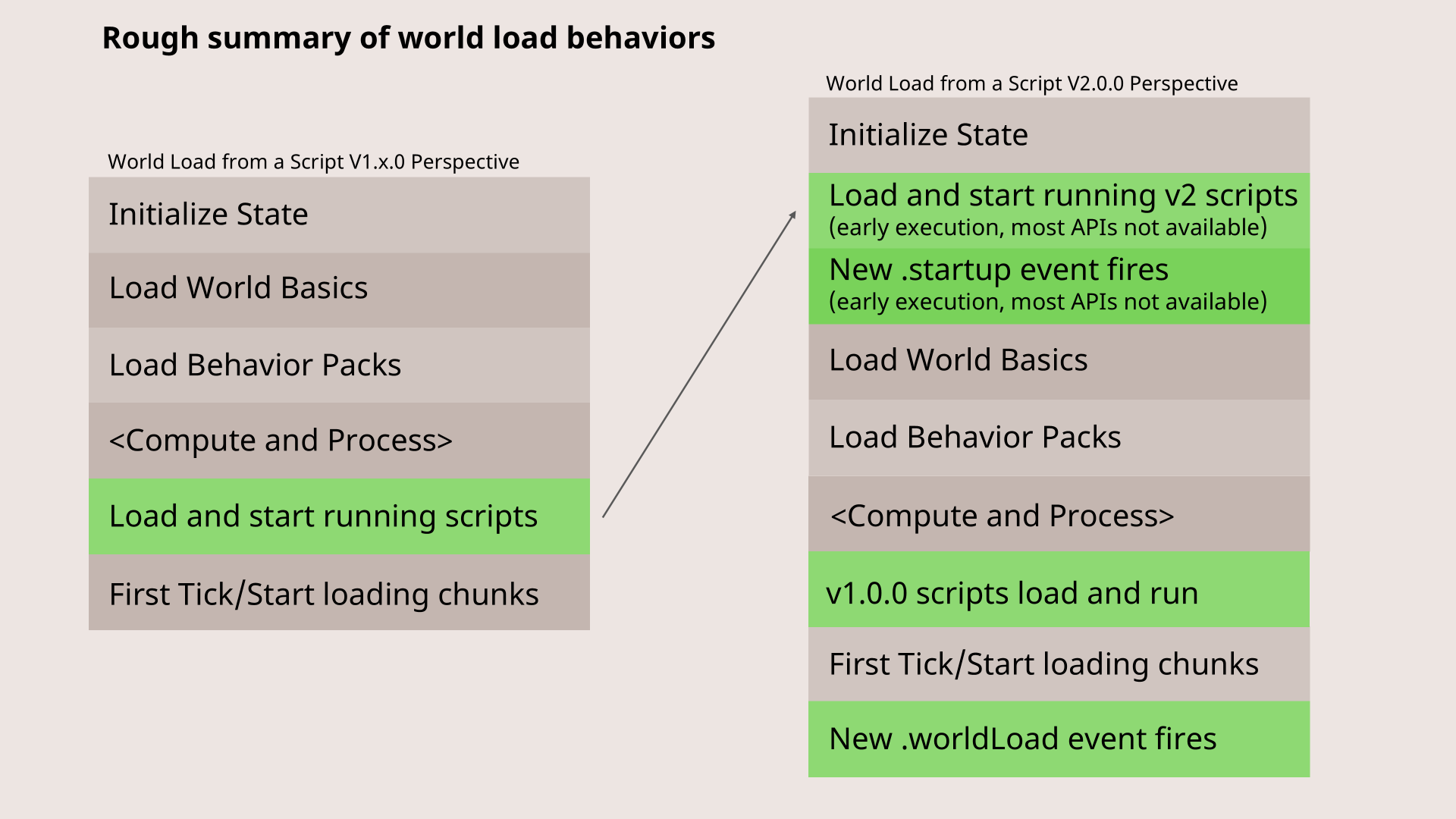
Image from Microsoft Creator Docs
A video verson available of worldLoad event walkthrough is available here (timestamp provided):
Contains a set of events that are available across the scope of the World.
Source